
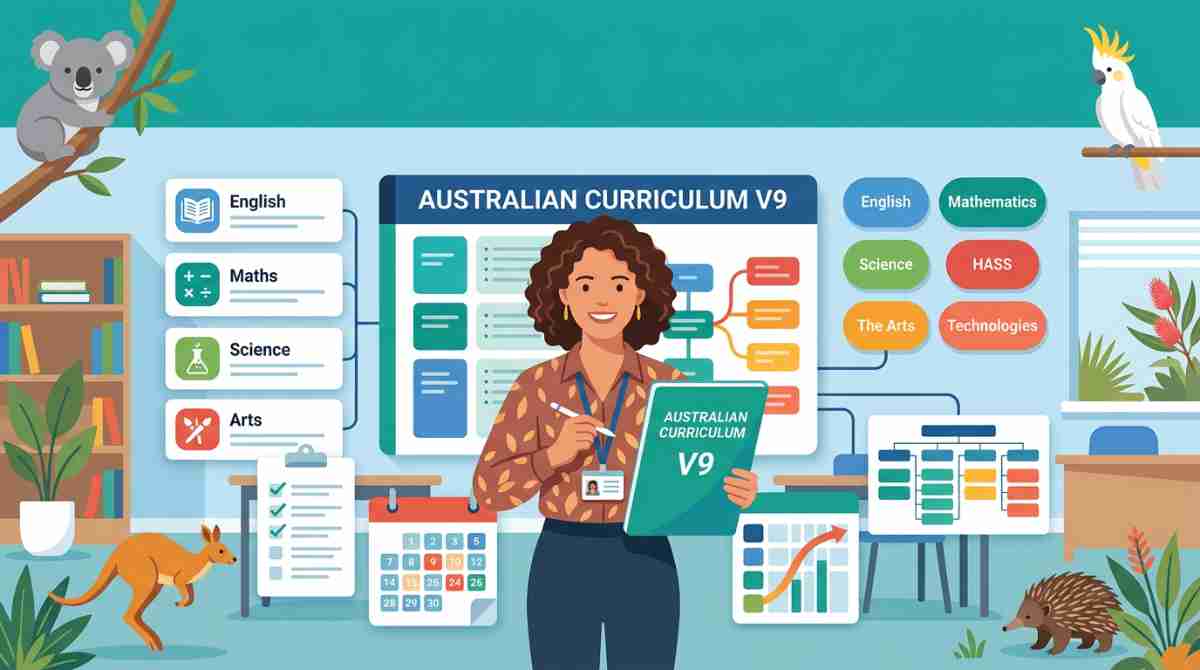
Version 9 is the most significant redesign of Australia’s national curriculum since it launched in 2010 – and teachers in every state and territory are now working with it.
Most teachers know V9 is different. Far fewer know exactly how – and that matters when you’re planning units from scratch.
What Is Australian Curriculum V9?
The Australian Curriculum, Version 9 (V9) is the national framework that sets out what Australian students from Foundation to Year 10 are expected to learn. It is written and maintained by the Australian Curriculum, Assessment and Reporting Authority (ACARA), a federal body established under the Australian Curriculum, Assessment and Reporting Authority Act 2008.
V9 organises learning across eight areas: English, Mathematics, Science, Humanities and Social Sciences (HASS), The Arts, Technologies, Health and Physical Education, and Languages. Sitting across all of them are seven general capabilities and three cross-curriculum priorities – the connective tissue that links content across subjects and year levels.
The framework is not a syllabus. Individual states and territories adopt V9 and then translate it into their own syllabuses, which means you will find differences in terminology, pacing and assessment guidance depending on where you teach. ACARA sets the architecture; your state or territory authority fills in the detail.
This distinction matters for teachers more than it might seem. When a colleague in another state describes how they’ve structured their unit around a particular content description, they may be working from a state syllabus that interprets V9 differently. The underlying V9 content description is the same; what surrounds it – the elaborations, the assessment guidance, the sequencing recommendations – can vary considerably.
V9 is also not the same as a programme of work. ACARA describes what students should learn and be able to do by the end of each year level or band. How teachers get there – the lessons, the resources, the daily sequencing – remains a matter of professional judgement. The curriculum sets the destination; the teacher plots the route.
What Changed from V8.4 to V9?
The shift from V8.4 to V9 was substantial. ACARA’s 2022 review touched every learning area and most structural elements of the curriculum. Understanding the changes is essential if you are planning units, updating scope-and-sequence documents, or reviewing assessment against achievement standards.
A useful way to frame the V9 changes is this: V8.4 told you a great deal about what students should engage with; V9 is more precise about what they should actually be able to do. That shift from breadth to precision runs through almost every change listed below.
The most significant changes were:
Fewer, sharper content descriptions. V8.4 was widely criticised for overcrowding. V9 reduced the total number of content descriptions across the curriculum and rewrote them to be clearer and more teachable. Each description now signals a more defined outcome rather than bundling multiple skills into one statement.
Refined achievement standards. The achievement standards in V9 are written at a finer grain and aligned more explicitly to content descriptions. Teachers moving from V8.4 will notice that the standards feel more usable for planning backwards from the end point of a unit.
Updated general capabilities. V8.4 had seven general capabilities. V9 retained all seven but significantly revised the frameworks behind each one. The ICT competence capability was replaced by Digital Literacy – a structural change that moves digital skills away from a standalone technology lens and into a cross-curriculum habit of mind. The other six capabilities – Literacy, Numeracy, Critical and Creative Thinking, Personal and Social Capability, Ethical Understanding, and Intercultural Understanding — were rewritten with clearer progressions and stronger links to learning area content.
For a full breakdown of all seven general capabilities and how they embed across subjects, see the general capabilities guide.
Revised cross-curriculum priorities. The three priorities – Aboriginal and Torres Strait Islander Histories and Cultures, Asia and Australia’s Engagement with Asia, and Sustainability – were retained but given updated priority elaborations. The aim was to move them from optional enrichment to genuine integration points within content descriptions and achievement standards.
For detail on how these three priorities operate in practice, see the cross-curriculum priorities explainer.
Cleaner structure across learning areas. Some learning areas reorganised their strand structure. Mathematics moved to three content strands – Number and Algebra, Measurement and Space, Statistics and Probability – with proficiency strands reframed to sit more clearly across all three. English retained its Language, Literature and Literacy strands but with revised sub-strands and a sharpened focus on reading and viewing.
- Endorsed refined F–10 curriculum for English, HPE, HASS, Mathematics, Science, Technologies and The Arts (ministers endorsed April 2022)
- New AC9 code system replaces legacy ACSSU / ACELA / ACMSP codes
- Fewer, sharper content descriptions — reduced crowding from V8.4
- Achievement standards re-aligned more tightly to content descriptions
- ICT Competence capability replaced by Digital Literacy
- Stronger cross-curriculum priority integration across all learning areas
- Explicit intercultural inquiry practices added to Science
- Mathematics reorganised into six strands (Number, Algebra, Measurement, Space, Statistics, Probability)
- Privacy and security content strengthened in Digital Technologies
Languages (F–10) endorsed separately: 10 May 2022 – 30 April 2024
- New elaborations for the Aboriginal and Torres Strait Islander Histories and Cultures cross-curriculum priority in Science F–10
- Updates to HASS — new elaboration in Year 4 and revised content description in Year 7
- Inclusion of Australian Curriculum: Languages (Classical and Auslan)
- General Capability and Cross-Curriculum Priority tagging revised to sub-element level across content descriptions and elaborations
- Languages expanded to include Hindi, Turkish, and the Framework for Aboriginal Languages and Torres Strait Islander Languages
- Parent support materials published
- Endorsed revised F–10 curriculum for English, Mathematics, Science, HASS, The Arts, Technologies and HPE
- Endorsed F–10 Languages for 11 languages: Arabic, Chinese, French, German, Indonesian, Italian, Japanese, Korean, Modern Greek, Spanish and Vietnamese
- Endorsed Work Studies, Years 9–10
ACSSU → Science Understanding
ACSIS → Science Inquiry
ACELY → English Literacy
ACELA → English Language
ACMSP → Maths Statistics
ACHHS → HASS History
AC9S3U01 → Science Yr 3
AC9S4I03 → Science Inq Yr 4
AC9EFLY09 → English Found
AC9E5LY05 → English Yr 5
AC9M3ST01 → Maths Yr 3
AC9HS4K05 → HASS Yr 4
When Was V9 Released and Implemented?
ACARA approved Version 9 on 1 April 2022. The documents were formally published on 10 May 2022, making V9 publicly available from that date.
Implementation is a separate story. Education in Australia is a state and territory responsibility, which means V9 did not switch on nationally on a single date. Each jurisdiction manages its own transition timeline, and the pace has varied considerably.
Most states and territories moved to full V9 implementation from 2023, though some allowed phased transitions where schools adopted V9 learning areas progressively rather than all at once. South Australia, Queensland, Western Australia and the other jurisdictions each published their own transition guidance documents alongside ACARA’s materials.
For a state-by-state breakdown of rollout timelines and what the transition means in practice, see the V9 implementation by state guide.
What Are the Eight Learning Areas in V9?
Every student in every Australian school from Foundation to Year 10 is taught within the eight learning areas of V9. Here is a brief descriptor of each, with links to the detailed guides on this site.
English – Reading, writing, speaking and listening across three interlocking strands: Language, Literature and Literacy. V9 sharpened the focus on reading and placed greater explicit attention on phonics in the early years. Read the full V9 English guide.
Mathematics – Structured around three content strands and four proficiency strands, V9 Maths reduced content crowding and introduced a stronger explicit link between content descriptions and achievement standards. Read the full V9 Mathematics guide.
Science – Organised around Science Understanding, Science Inquiry Skills, and Science as a Human Endeavour. V9 placed greater emphasis on inquiry as a genuine investigative process rather than a formulaic procedure. Read the full V9 Science guide.
Humanities and Social Sciences (HASS) – HASS covers History, Geography, Economics and Business, and Civics and Citizenship in the one learning area for primary and lower secondary. V9 refined the inquiry skills framework that runs across all four subjects. Read the full V9 HASS guide.
The Arts – Covers five art forms: Dance, Drama, Media Arts, Music, and Visual Arts. Each is a distinct subject within the learning area. V9 updated the making-and-responding structure that applies across all five. Read the full V9 Music guide and the V9 Media Arts guide.
Technologies — Spans two distinct subjects: Design and Technologies, and Digital Technologies. Digital Technologies received the most significant update in V9, with explicit coding and computational thinking requirements from Foundation. Read the full V9 Digital Technologies guide.
Health and Physical Education (HPE) – HPE was not part of the major 2022 restructure in the same way as other learning areas, though V9 made some updates to content descriptions and standards.
Languages – Languages is managed through a framework that covers a large number of individual languages taught across Australian schools. V9 updated the structure of the Languages framework, which applies across all languages taught.
General Capabilities and Cross-Curriculum Priorities
The eight learning areas are the bones of V9. General capabilities and cross-curriculum priorities are what holds it together.
General capabilities are skills and dispositions that students develop across all subjects, not in any single one. V9 identifies seven: Literacy, Numeracy, Digital Literacy, Critical and Creative Thinking, Personal and Social Capability, Ethical Understanding, and Intercultural Understanding. They appear as icons tagged to content descriptions across every learning area, signalling where teachers are expected to embed capability development into subject-specific teaching.
The shift from ICT Competence to Digital Literacy in V9 is the most structurally significant change to the general capabilities framework. Digital Literacy in V9 is broader than the old ICT framing – it includes skills around evaluating information, understanding privacy, recognising the social implications of technology, and creating digital content responsibly.
The other six capabilities were not just renamed; their frameworks were rewritten with clearer progressions and stronger links to learning area content. Critical and Creative Thinking, for instance, now has more explicit sub-elements – including reflecting, questioning, and generating ideas – that connect more directly to content descriptions in Science, English, and HASS. Ethical Understanding has been updated to make the reasoning process more explicit, not just the outcomes. The intent across all seven is to make capability embedding feel like a natural part of planning rather than an afterthought.
Cross-curriculum priorities are different in kind from general capabilities. Rather than describing skills, they identify areas of knowledge and perspective that ACARA considers essential for all Australian students regardless of subject. The three priorities – Aboriginal and Torres Strait Islander Histories and Cultures, Asia and Australia’s Engagement with Asia, and Sustainability – appear as elaborations embedded within content descriptions rather than as separate add-ons.
Both general capabilities and cross-curriculum priorities require something of teachers that V8.4 did not always make explicit: they ask you to plan with them in mind from the outset, not layer them over existing units after the fact.
For the full breakdown of all seven capabilities and how to embed them, see the general capabilities guide.
How to Access and Reference V9
The full V9 curriculum documents are freely available at australiancurriculum.edu.au. There is no login required, and you can browse by learning area, year level, strand, or content description. ACARA also provides downloadable PDFs of curriculum documents by learning area, which many schools keep on their servers for offline planning.
If you need the APA 7 citation for the curriculum in a document or research context, the format is:
Australian Curriculum, Assessment and Reporting Authority. (2022). The Australian Curriculum (Version 9.0). https://australiancurriculum.edu.au
For Harvard format, a step-by-step guide and instructions for citing specific learning areas and content descriptions, see the V9 access and citation guide.
Is the Australian Curriculum Mandatory?
The short answer is: mostly yes, but through state and territory authority rather than ACARA directly.
ACARA has no power to mandate curriculum implementation. That authority sits with state and territory governments, each of which has its own education department and its own legal framework governing schooling. When a state education department officially adopts V9 – as all jurisdictions are now doing – it becomes mandatory for state government schools in that jurisdiction. Catholic systemic and independent schools typically follow the same curriculum framework, though with some flexibility in implementation.
What this means in practice is that the curriculum content descriptions and achievement standards in V9 are binding on teachers in government schools where V9 has been officially adopted. The pedagogical approach – how you teach – is not prescribed by the curriculum.
Some independent schools, particularly those following an alternative educational philosophy such as Montessori or Steiner, may operate under different frameworks, but they remain subject to their state’s broader regulatory requirements around curriculum coverage.
There is one further wrinkle worth knowing. Even within a single state, not every school is at the same point in the V9 transition. Some state education departments staged implementation across learning areas rather than switching everything at once. A school might be teaching V9 Mathematics while still finishing out a V8.4-aligned English program. If you have moved schools recently, it is worth confirming which version of the curriculum your new school is operating in for each learning area rather than assuming V9 across the board.
ACARA publishes a clear set of FAQs about curriculum authority and implementation on its website, and state education departments publish their own transition guidance. The state implementation guide on this site summarises the jurisdiction-by-jurisdiction picture in plain language.
How to Navigate V9 as a Working Teacher
The sheer volume of documentation in V9 can be overwhelming when you first approach it. ACARA’s website is comprehensive, but it is not always easy to find what you need quickly, particularly if you teach across multiple year levels or learning areas.
A practical starting point is to work by learning area rather than trying to understand V9 as a whole. Identify the learning area you are planning for, go to that section of australiancurriculum.edu.au, and filter by your year level. From there, you can read content descriptions, check the corresponding achievement standards, and look at the elaborations that accompany each description. The elaborations are not mandatory – they are examples of how you might address a content description – but they are rather useful for teachers who are new to a year level or subject.
If you are updating existing units from V8.4, ACARA published mapping documents that match V8.4 content descriptions to their V9 equivalents. These are imperfect – some descriptions changed significantly rather than just being reorganised – but they provide a starting scaffold for revision rather than requiring you to build from scratch.
The general capabilities require a different approach. Rather than reading the full capability frameworks (which are lengthy and detailed), a more practical method is to start with the content descriptions you are already planning to teach, identify which capability icons are tagged to those descriptions, and then look up what that capability asks of students at your year level. This keeps capability planning grounded in your actual teaching rather than becoming an abstract exercise.
V9 is a living document in the sense that ACARA reviews and may update it over time. The version published in May 2022 is Version 9.0. Future updates, if any, would be published as Version 9.1 or higher. Checking the version number on any downloaded PDFs or third-party resources before using them is good practice, particularly for resources that were produced early in the transition period and may reflect draft rather than final content.
V9 FAQs
What is Australian Curriculum Version 9?
Australian Curriculum Version 9 is the current edition of Australia’s national framework for what students learn from Foundation to Year 10. Published in May 2022 and endorsed by education ministers in April 2022, V9 replaced V8.4 with sharper content descriptions, revised general capabilities, and stronger links between content and achievement standards across all eight learning areas.
When was Australian Curriculum V9 introduced?
ACARA’s Version 9 was endorsed by education ministers on 1 April 2022 and officially published on 10 May 2022. State and territory implementation began progressively from 2023. The transition timeline varies by jurisdiction – see the state implementation guide for details.
What changed between Australian Curriculum V8.4 and V9?
The key changes were: a significant reduction in the number of content descriptions to reduce crowding; revised and more explicit achievement standards; the replacement of ICT Competence with Digital Literacy as a general capability; updated cross-curriculum priority elaborations embedded more deeply into content descriptions; and substantial restructuring in several learning areas, particularly Mathematics and Digital Technologies.
Is Australian Curriculum V9 mandatory in all states?
V9 is not mandated directly by ACARA – that power sits with state and territory governments. All Australian jurisdictions have moved to adopt V9, though implementation timelines differ. See the implementation by state guide for the rollout schedule.
Who writes the Australian Curriculum?
The Australian Curriculum, Assessment and Reporting Authority (ACARA) writes and maintains the national curriculum. ACARA is a federal statutory authority established under Commonwealth law. It works with state and territory curriculum authorities, education ministers, and school sector representatives during development and review processes.
How do I cite Australian Curriculum V9 in APA 7 format?
The standard APA 7 citation is: Australian Curriculum, Assessment and Reporting Authority. (2022). The Australian Curriculum (Version 9.0). https://australiancurriculum.edu.au – For Harvard format and citations for individual learning areas, see the full citation guide.
Where can I download the Australian Curriculum V9 PDF for free?
The V9 PDFs are available at no cost directly from ACARA’s website at australiancurriculum.edu.au. Learning area PDFs can be downloaded from each subject’s landing page. For step-by-step instructions on finding and accessing the PDFs, see the access and citation guide.
How is V9 different from the previous version?
V9 is a structural revision, not a cosmetic update. The most visible differences are fewer content descriptions, a renamed and expanded Digital Literacy capability, stronger cross-curriculum priority integration, and clearer achievement standards. The eight learning areas remain, but most received internal restructuring of strands, content descriptions, or both.
Which states have implemented V9 and when?
All Australian states and territories have committed to V9 implementation, with most government schools transitioning from 2023. The pace of rollout – and how states phased the transition across learning areas – varies. The state-by-state implementation guide covers each jurisdiction in detail.
What are the eight learning areas in V9?
English, Mathematics, Science, Humanities and Social Sciences (HASS), The Arts, Technologies, Health and Physical Education, and Languages. Each is a standalone learning area with its own content structure, strands, and achievement standards. All eight are covered in this guide with links to the dedicated cluster guides for each.
Does V9 change what subjects are taught in Australian schools?
V9 does not add or remove subjects. The eight learning areas remain the same as V8.4. Within those areas, some sub-structure changed – most notably Digital Technologies within Technologies, and individual art forms within The Arts – but no entirely new curriculum subject was created and none was removed.
Where can I find the V9 glossary?
ACARA publishes a curriculum glossary as part of the V9 documentation at australiancurriculum.edu.au. The glossary defines key terms used across content descriptions, achievement standards, and general capabilities. It is searchable by term and is updated alongside the main curriculum documents.
Explore the V9 Learning Areas
Every learning area in the Australian Curriculum V9 has a dedicated guide on this site. Use these to go deeper on the learning areas you teach.
- Australian Curriculum V9 Mathematics – What Changed and What It Means
- Australian Curriculum V9 English – What Teachers Need to Know
- Australian Curriculum V9 Science – A Complete Classroom Guide
- Australian Curriculum V9 HASS – Humanities and Social Sciences Explained
- Australian Curriculum V9 Music – What Changed and How to Teach It
- Digital Technologies in Australian Curriculum V9 – What Changed for Teachers
- General Capabilities in Australian Curriculum V9 – What Every Teacher Must Know
- V9 Cross-Curriculum Priorities – Sustainability, First Nations and Asia
- How to Access and Cite Australian Curriculum V9 – PDF, APA and Official Links
- Australian Curriculum V9 Implementation – State and Territory Timeline