
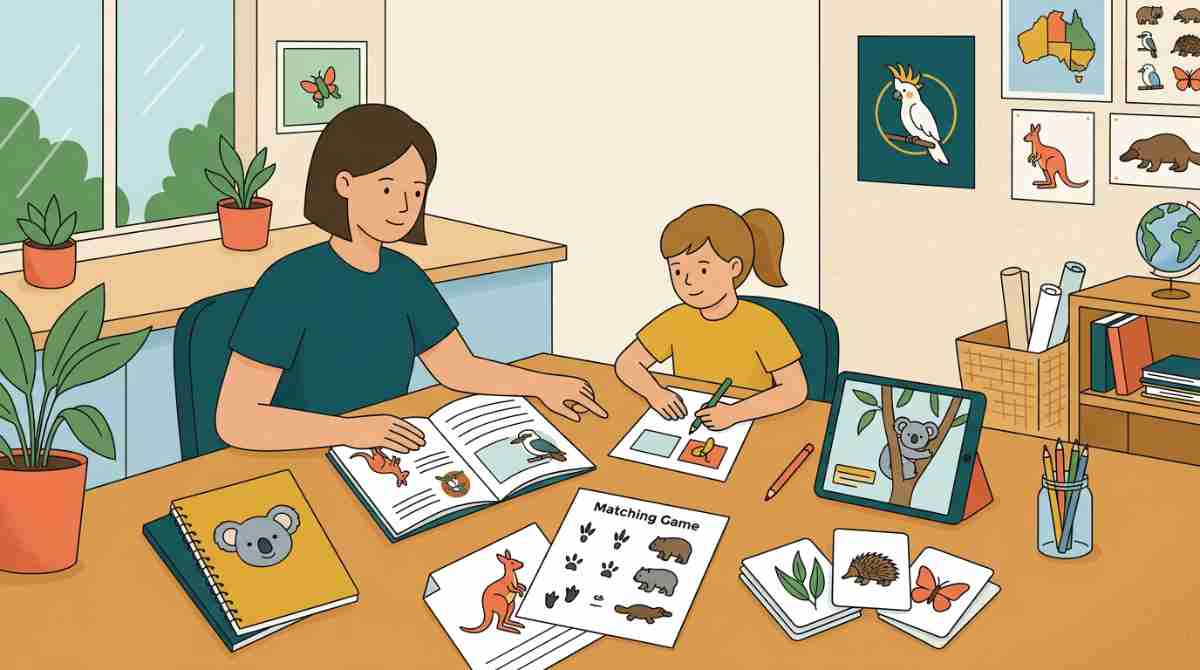
Whether you homeschool full-time, tutor after school, or just want to keep science alive in the holidays, Australian wildlife gives you the richest possible starting point – and this is where everything on AussieAnimals.com for learners at home lives.
Something shifts when a child realises the animal they’re studying isn’t a picture in a textbook – it’s the bird outside the window, the spider under the letterbox, the possum that keeps raiding the compost. That shift is the difference between learning about science and starting to think like a scientist.
AussieAnimals.com was built around that idea. Our articles, guides, and teaching resources on this site all start with real Australian animals in real Australian places. Not because Australian wildlife is a convenient curriculum hook, but because it is extraordinary – and children who grow up learning about it tend to carry that curiosity for life.
Our home learning hub brings together every resource on this site designed for families, homeschoolers, and after-school tutors. Use it as your starting point, your reference map, or just the page you bookmark and return to when you’re planning a new unit.
Who this section is for
Homeschooling families running a structured curriculum at home – whether that’s fully Australian Curriculum-aligned, a Charlotte Mason approach, an eclectic mix, or something you’ve designed yourself. The homeschool science guides and curriculum-aligned packs on this site are written with your planning needs in mind.
Parents and tutors supporting school-age children outside the classroom – after-school sessions, holiday programs, or supplementary learning when a child needs more depth or a different approach than the classroom is providing. The activity guides and printable packs work just as well on a kitchen table as in a formal learning environment.
Educators looking for extension resources – classroom teachers, learning support teachers, and school library staff who want to bring Australian wildlife into lessons beyond what the standard curriculum provides. The teacher-facing resources on this site are a separate section, but there’s significant overlap, and everything here can be adapted for classroom use.
If you’re a classroom teacher looking for structured, assessment-ready teaching packs, the Australian Wildlife Teaching Packs are the better starting point. This section is built for learning that happens outside the formal school day.
Why Australian animals work so well for home learning
Every homeschool science approach eventually needs a content anchor – something tangible, local, and interesting enough to hold a child’s attention long enough for real learning to happen. Australian wildlife is one of the best possible choices, for reasons that go well beyond novelty.
They’re observable. Unlike the megafauna that fills most international science curricula, Australian animals are accessible. Kookaburras, blue-tongue lizards, garden orb-weaver spiders, and eastern water dragons are not zoo exhibits – they’re neighbours. Observation, which is the foundation of scientific thinking, is possible from a suburban backyard.
They’re curriculum-aligned. The Australian Curriculum v9 Biological Sciences strand – from living things and their needs in the early years through to ecosystems and biodiversity in upper primary – maps naturally onto Australian animal study. A unit on food chains practically writes itself when you’re working with local predators and prey.
They’re cross-curricular. A study of the platypus covers biology, evolutionary history, Indigenous knowledge systems, conservation policy, and mathematics. The best animal units naturally become literacy units – reading non-fiction, writing research reports, building scientific vocabulary. They become geography units when you map habitat ranges. They become values discussions when you talk about extinction risk.
They’re motivating. Children who grow up in Australia often arrive at school already interested in the wildlife around them. That pre-existing curiosity is a gift. Home learning that builds on what a child already loves is far easier to sustain than content that competes with their interests.
The home learning resources on our site
The guides and resources here are organised into three main, each targeting a different kind of home learning need.
1. Homeschool science using Australian animals
This is the core curriculum cluster – guides for homeschooling families building structured science units around Australian wildlife, aligned to AC v9.
The Homeschool Science Using Australian Animals curriculum guide maps the Biological Sciences strand from Years 3 to 6, explains how to structure a unit around a Big Inquiry Question, and links to the activity guides and printable resources that support each unit. Start here if you’re planning a formal science term.
Supporting guides we cover:
- Food chains using Australian animals – hands-on activities, key vocabulary, and inquiry questions that make producer-consumer-decomposer chains tangible for Years 3 and 4. Includes a natural pathway to the Mini Pack in the store.
- Australian animal project ideas for primary students – ten project-based learning approaches that build research skills, science understanding, and writing ability simultaneously. Suited to Years 3 through 6.
- Nature study for Australian homeschool families – a method guide for families using observation and field journalling as their primary science approach. Covers how to connect informal nature study to AC v9 Science Inquiry Skills for registration purposes.
- Printable Australian animal activities for school holidays – free and premium printable resources for holiday programs and informal home learning. Bridges to the AussieAnimals.com store.
- Using animal fact files for reading practice – a literacy-science crossover guide showing how to use structured fact files to build non-fiction reading comprehension, scientific vocabulary, and note-taking skills.
2. Homeschooling in Australia – the complete guides
For families still in the research and planning stages of homeschooling, or navigating a specific challenge, this cluster covers the practical, legal, and emotional dimensions of home education in Australia.
The Homeschooling in Australia Complete Guide covers registration, legal requirements by state and territory, curriculum options, costs, and socialisation in one comprehensive reference. It’s the right place to start if you’re new to homeschooling or considering the move.
Supporting guides cover Centrelink and funding, school refusal, parental burnout, and the homeschool versus public school comparison – all with Australian data and Australian-specific legal context.
3. Outcomes, age, stages and socialisation
This cluster answers the questions most families carry quietly – does it actually work, when should we start, is it too hard at this age, what about socialisation, will our child be able to get into university?
The Does Homeschooling Work research guide, the Best Age to Start Homeschooling year-by-year guide, and the How to Socialise a Homeschooled Child practical guide form the core of this cluster. Each is built around published research and Australian-specific evidence, not anecdote.
How to use the AussieAnimals.com store for home learning
The printable teaching packs in the AussieAnimals.com store are curriculum-aligned resources built specifically for Australian animal study. They were designed with classroom teachers in mind but work equally well for homeschooling families and tutors.
Each pack is structured around a Big Inquiry Question – an open-ended science question that gives a unit its narrative spine. Activities, student workbooks, and assessment tasks are all tied back to that central question, which means the pack functions as a complete mini-unit rather than a collection of disconnected worksheets.
Mini Packs are single-topic, single-session resources – a food chain activity card set, a habitat matching game, an animal adaptations sorting task. Suited to holiday programs, one-off science afternoons, or supplementing a unit already in progress.
Standard Packs cover a full topic across multiple sessions, with student workbook pages, teacher guide notes, and an assessment task. Suited to a week-long unit block.
Premium Packs are complete teaching units – typically two to three weeks of structured learning, with differentiated activities, First Nations connections, and full curriculum mapping. The Years 3–4 Habitats and Food Chains Premium Pack is the most comprehensive resource currently available.
All packs come as PDF downloads, designed to be printed and filed – the activities are reusable across multiple children and multiple years.
Where to start if you’re new here
If you’ve landed on this page without a clear destination in mind, here are three useful entry points depending on what you need right now.
Planning a science unit for a child in Years 3–6: Homeschool Science Using Australian Animals guide. It maps the curriculum, suggests a unit sequence, and links to every supporting resource.
Researching whether homeschooling is right for your family: Homeschooling in Australia Complete Guide. Registration, costs, curriculum, and socialisation with Australian-specific detail.
Need something for school holidays this week: Printable Australian Animal Activities for School Holidays. Free resources available, plus printable packs in the store if you want something more structured.
A note on how this content is written
The curriculum-aligned teaching packs in the store are cross-referenced against AC v9 Science and English strand descriptors for the relevant year levels. Conservation status references use EPBC Act terminology. First Nations connections, where included, are drawn from attributed sources.
If you find an error, an outdated reference, or a resource that doesn’t work as described, use the contact page to let us know – we aim to continuously improve our resources.
FAQ
What age group is the home learning content on AussieAnimals.com aimed at?
The curriculum guides and teaching packs are primarily designed for primary-school-age children – Years 1 through 6, with the most detailed resources covering Years 3 to 6. The nature study and general wildlife content on the site is suitable for all ages, including older students and adults with a genuine interest in Australian wildlife.
Do I need to follow the Australian Curriculum to use these resources?
No. The curriculum alignment is there for families and educators who need it – it makes it easier to show that your homeschool program meets registration requirements, and it gives classroom teachers a clear rationale for using a resource. The activities and guides work equally well for families following a Charlotte Mason, unschooling, or eclectic approach. The science is the same regardless of which framework you’re using.
Are the teaching packs in the store different from the free articles?
Yes, in structure and depth. The free articles explain concepts, suggest approaches, and provide a planning framework. The teaching packs in the store are complete, print-ready resources – student workbook pages, activity cards, teacher guide notes, and assessment tasks, all formatted for immediate use. Think of the articles as the planning layer and the packs as the delivery layer.
Can I use these resources if I’m a classroom teacher, not a homeschooler?
Absolutely. The home learning framing reflects the primary audience for this section of the site, but nothing here is exclusive to homeschoolers. The teaching packs were originally designed with classroom teachers in mind. The activity guides and nature study resources work in a school garden, a library corner, or a structured classroom lesson just as well as at a kitchen table.
Does AussieAnimals.com cover high school science as well as primary?
Not yet. The current resources are focused on primary school (Years 1–6), with the most developed content at Years 3–4 and Years 5–6. High school content is a planned expansion. The research and outcomes content in the homeschool cluster covers the high school transition, including ATAR pathways and university entry, but the teaching resources themselves are primary-focused for now.
How often is new home learning content added to the site?
New articles and resources are published on a rolling schedule. The best way to stay across new releases is to join the AussieAnimals.com newsletter – new packs, free resources, and seasonal activity guides are announced there before anywhere else.
All curriculum references on this site use Australian Curriculum v9.0. Conservation status references use EPBC Act 1999 terminology. Teaching pack content is the original work of AussieAnimals.com and is subject to copyright.