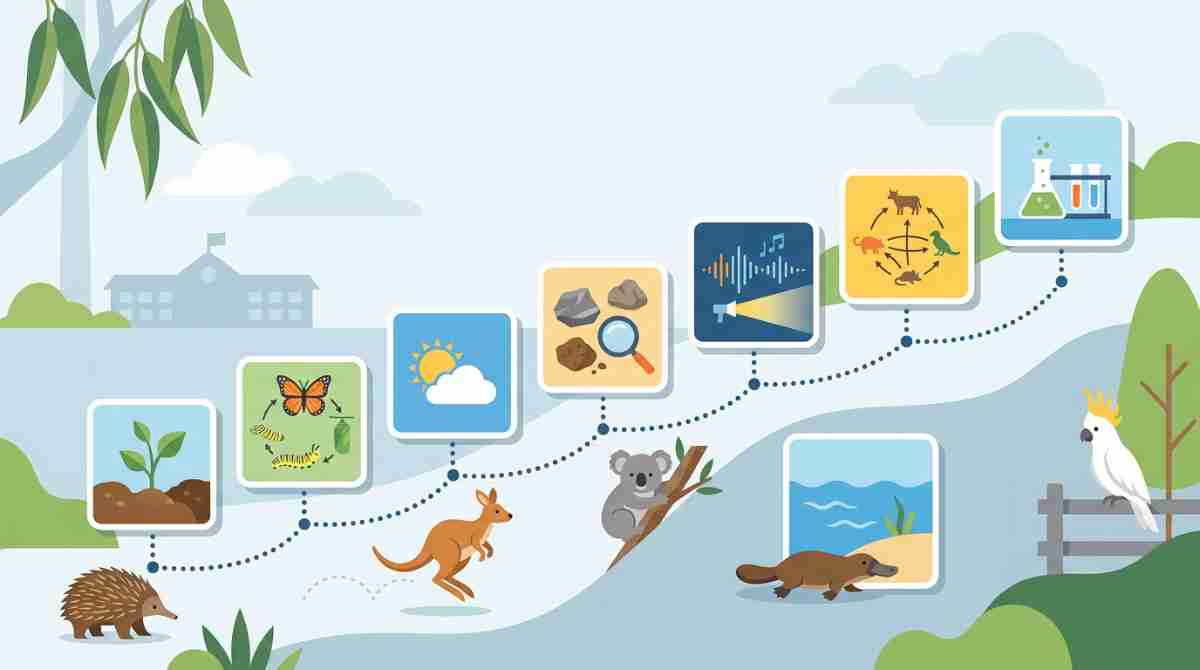
From Foundation living-things investigations to Year 6 biodiversity units, this guide maps what AC v9 expects at every primary year level – and where Australian wildlife fits in.
Every year level has a different science challenge. These Australian curriculum guides show exactly what students learn – and which native animals make the teaching unforgettable
Australian Year Level Guides – What Every Year Group Learns in Science
The Australian Curriculum does not progress evenly. Every year level marks a genuine shift – from observing to explaining, from classifying to predicting, from food chains to food webs. A teacher walking into Year 3 for the first time and a parent trying to understand why their Year 5 student is suddenly talking about ecosystem collapse are often starting from the same place: they want a clear map of what this year level actually demands.
That’s what our AussieAnimals guide is.
What follows is a year-by-year breakdown of the Australian Curriculum v9 science strand for Foundation through Year 6, anchored in the living world content that connects most directly to Australian wildlife. Each year level gets its own section: what changes from the year before, which concepts students encounter for the first time, and which native animals and environments make those concepts tangible.
Each section also links to deeper resources – full year-level guides, worksheet collections, and teaching packs — for teachers who want to go further.
Australian Year Levels at a Glance
The table below maps each primary year level to its typical student age, the central science concept under AC v9, and the curriculum band it sits in. The Year 7–10 column is included for orientation – AussieAnimals resources focus on Foundation through Year 6.
| Foundation | Year 1 | Year 2 | Year 3 | Year 4 | Year 5 | Year 6 | Year 7–10 |
| Age 4–5 | Age 5–6 | Age 6–7 | Age 7–8 | Age 8–9 | Age 9–10 | Age 10–11 | Age 11–15+ |
| Living vs non-living | Animal needs | Habitats | Food chains | Animal adaptions | Ecosystems & food webs | Biodiversity | Senior science |
Note: Year 7 sits in primary school in some states (NSW, VIC, WA, TAS) and in high school in others (QLD, SA, ACT). Curriculum content at Year 7 follows AC v9 regardless of school type.
How AC v9 Structures Science – The Living World Progression
The Australian Curriculum Science strand is built from four sub-strands: the Living World, the Physical Sciences, Earth and Space Sciences, and Chemical Sciences. This guide focuses primarily on the Living World, because it is the strand where Australian wildlife connects most directly to classroom content – and where the conceptual progression across year levels is steepest.
The Living World strand moves through a clear arc across primary school:
Foundation – What is alive? Students observe and describe the features of living and non-living things. The science is concrete, sensory, and observation-driven.
Year 1 – What do living things need? Students investigate the basic needs of plants and animals — food, water, shelter, air — and begin to connect those needs to the environments where animals live.
Year 2 – Where do animals live, and why? Habitats become the organising concept. Students explore how a habitat meets an animal’s needs and begin to see environments as systems.
Year 3 – How are living things connected? Food chains introduce the idea that organisms depend on each other. Classification adds a second thread – grouping animals by observable features.
Year 4 – Why do animals look the way they do? Adaptations shift the focus from description to explanation. Students begin to reason about why features exist, not just what they look like.
Year 5 – How do ecosystems work? Food chains become food webs. The concept of interdependence moves from pairs of organisms to entire systems – and students start to think about what happens when that system is disturbed.
Year 6 – What is at stake? Biodiversity becomes the lens. Students investigate the variety of life in Australian environments, the threats facing that variety, and the human choices that determine what survives.
Each year level in this progression builds directly on the last. A student who cannot construct a food chain in Year 3 will struggle with food webs in Year 5. A student who has not understood animal needs in Year 1 will find habitats abstract in Year 2. These guides are designed to be read as a sequence, not as isolated snapshots.
Foundation Year Science – Learning to See the Living World
Foundation science begins where all science begins: with looking. Before a child can classify an animal, they need to have noticed it. Before they can explain a food chain, they need to understand that the blue-tongue lizard sunning itself on the garden path is alive and the rock beside it is not.
The Foundation year science strand asks students to observe and describe the features of living things, and to begin to sort objects and organisms into categories. There is no formal hypothesis, no experiment design, no written explanation. The tools are a student’s own eyes, a pencil, and a set of well-chosen questions from the teacher.
Australian wildlife is an ideal Foundation science tool for one simple reason: native animals are genuinely different from each other in observable ways. A gecko, a worm, a galah, and a bandicoot do not look remotely alike, yet all are alive. The contrast that makes them scientifically useful is the same contrast that makes them visually arresting. Foundation students do not need to be sold on looking closely at a thorny devil.
Foundation science is not about knowing facts. It is about building the habits of noticing – the disposition to look carefully, ask questions, and record what is actually there rather than what a student expects to see.
AC v9 Foundation science covers all four science sub-strands, but the Living World strand – specifically the observable features and basic needs of living things — is the most natural entry point for wildlife-based classroom activities.
Resources for Foundation Year →
Foundation Science Resources for Australian Prep Classrooms – /foundation-science-resources-australia
Prep Living Things Activities Using Australian Animals – /prep-living-things-activities-australia
Year 1 Science – What Living Things Need to Survive
The shift from Foundation to Year 1 is the shift from observation to explanation. Foundation students learn to notice that a kangaroo is alive. Year 1 students begin to ask what the kangaroo needs in order to stay alive.
The central concept is needs – specifically, the basic needs of plants and animals: food, water, shelter, and in most cases, air. This sounds straightforward, but in practice it opens a rich field of investigation. What does a wombat eat? Where does a sugar glider shelter during the day? How does a pelican get its water? Each question connects directly to a specific Australian animal and a specific AC v9 content descriptor.
Year 1 is also where the link between an animal and its environment begins to form. Students do not yet study habitats formally – that is Year 2 territory – but they begin to notice that different animals need different things, and that those differences connect to where the animals live. The groundwork for habitat thinking is laid here.
For teachers, Year 1 science is an opportunity to build scientific vocabulary from the ground up. Words like features, needs, survive, and environment should become part of students’ working language by the end of Year 1. Native Australian animals – with their often-dramatic physical features and their easily-researched needs – are ideal vocabulary anchors.
Resources for Year 1 →
Year 1 Science Worksheets Featuring Australian Wildlife — /year-1-science-worksheets
What Should a Year 1 or Year 2 Child Know in Science — /what-should-year-1-year-2-child-know-science
Year 2 Science – Habitats and Why Animals Live Where They Do
Year 2 is where the environment becomes a subject, not just a backdrop. Students who spent Year 1 asking what animals need now ask where those needs are met – and the answer is: in a habitat.
A habitat is not just a location. It is a place that provides everything a particular animal needs to survive. The rainforest is a habitat for the cassowary because it provides the fruit the cassowary eats, the dense vegetation it needs for shelter, and the water it drinks. The same rainforest is not a habitat for the thorny devil, which cannot survive in it. Year 2 students begin to understand this specificity – that the match between animal and habitat is not accidental.
Australia’s ecological diversity makes it exceptional for Year 2 habitat teaching. In most countries, teachers illustrate habitats with two or three examples – forest, grassland, perhaps ocean. Australian teachers have access to arid desert, tropical rainforest, temperate woodland, alpine meadow, coral reef, mangrove, and saltmarsh – all within a single national curriculum context, and all populated with native animals that students can research and discuss.
The five Australian habitats that work best for Year 2 classroom investigations are arid/desert, tropical rainforest, coastal/marine, temperate woodland, and urban green space. Each has well-documented native fauna, strong photographic resources, and clear connections to AC v9 content descriptors.
Resources for Year 2 →
Year 2 Animal Habitats Activities for Australian Classrooms – /year-2-animal-habitats-activities
Year 3 Science – Food Chains and Classifying Living Things
Year 3 marks the first major conceptual leap in the Living World strand. Students stop describing individual animals and their environments and start mapping the relationships between them.
Food chains are the primary vehicle for this shift. A food chain shows the sequence in which energy moves through a system — from the sun to a plant (the producer), from the plant to the animal that eats it (the consumer), and from that animal to the predator that eats it. For Australian students, this can be as concrete and local as: native grass → eastern grey kangaroo → dingo.
The word that matters in Year 3 food chain teaching is not food – it is direction. The arrows in a food chain show the direction of energy transfer, not the direction of eating. This is a genuine conceptual stumbling block for many Year 3 students, and it requires explicit teaching rather than incidental exposure.
Year 3 also introduces classification – the practice of sorting living things into groups based on shared observable features. Vertebrate and invertebrate are the primary categories. Australian wildlife gives teachers an unusually rich classification toolkit: the platypus alone can anchor a productive lesson on why classification systems require careful definitions.
Resources for Year 3 →
Year 3 Science Worksheets Featuring Australian Wildlife – /year-3-science-worksheets
What Australian Students Learn in Year 3 and Year 4 Science – /year-3-year-4-science-expectations-australia
Year 4 Science – Animal Adaptations and the Logic of Evolution
The Year 3 to Year 4 progression is one of the most significant in the primary science curriculum. Year 3 asks: what features does this animal have? Year 4 asks: why?
Adaptations are features – structural or behavioural – that increase an animal’s chances of surviving and reproducing in a particular environment. This is science at its most explanatory. Students are not listing facts about animals; they are constructing arguments about why those facts make sense.
Australian animals are the world’s best teaching material for Year 4 adaptations, and this is not an exaggeration. The thorny devil has microscopic channels between its scales that draw dew up toward its mouth – it drinks through its skin. The platypus detects electrical fields generated by the muscle movements of its prey, hunting without using sight, smell, or hearing underwater. The sugar glider has a membrane between its wrist and ankle that allows it to glide 50 metres between trees without flapping once.
These are not exotic curiosities. They are precisely the kind of specific, explainable, evidence-based phenomena that Year 4 adaptations teaching requires. And unlike many curriculum examples drawn from African or European wildlife, Australian students have the genuine possibility of encountering these animals.
The most common Year 4 adaptation misconception: students often describe a feature as an adaptation without explaining what it is an adaptation for. The teaching task is to close that gap – “the echidna has spines” is description; “the echidna’s spines deter predators by making it painful and difficult to pick up” is an adaptation explanation.
Resources for Year 4 →
Year 4 Animal Adaptations Worksheets Using Australian Species — /year-4-animal-adaptations-worksheets
Year 5 Science – Ecosystems, Food Webs, and Interdependence
Year 5 is where the Living World strand becomes genuinely complex. Food chains, which Year 3 students learn as linear sequences, expand into food webs – and food webs reveal something food chains cannot: that living things in an ecosystem are not connected in simple pairs, but in a dense, interdependent network where the removal of one species can reshape everything.
The word that defines Year 5 science is interdependence. An ecosystem is not a collection of organisms that happen to share a space. It is a system in which each organism depends, directly or indirectly, on many others. The removal of a top predator changes prey populations. Changed prey populations change plant communities. Changed plant communities change soil quality and water retention. Year 5 students begin to trace these cascades – and Australian ecosystems, which have been subjected to some of the most dramatic biodiversity changes of any country on Earth, provide real and current examples of exactly this kind of cascade.
The dingo is perhaps the most instructive. In areas where dingoes have been removed, populations of kangaroos and wallabies increase unchecked, overgrazing vegetation and compacting soil, which in turn affects small mammal populations that depend on ground cover. Year 5 students can trace this chain with real Australian data.
Resources for Year 5 →
Year 5 Science Worksheets Exploring Australian Ecosystems — /year-5-science-worksheets
Year 5 Ecosystems — Australian Wildlife Investigations for AC v9 — /year-5-ecosystems-australia
Year 6 Science – Biodiversity, Conservation, and Human Impact
Year 6 is the final year of primary science, and AC v9 ends the Living World strand with its most urgent question: what happens to ecosystems when the variety of life within them is reduced?
Biodiversity is the technical term – it refers to the variety of life at every scale, from the genetic diversity within a species to the species diversity within a habitat to the ecosystem diversity across a landscape. Year 6 students investigate what biodiversity means, why it matters, and what threatens it.
Australia is one of the world’s 17 megadiverse countries – a designation given to nations that together contain more than 70 per cent of Earth’s plant and animal species. It is also one of the countries with the highest rate of mammal extinctions in recorded history. These two facts sit alongside each other in a way that is both scientifically important and personally meaningful for Australian students. Year 6 biodiversity is not abstract. It is about the animals in the students’ own country.
The EPBC Act — the Environment Protection and Biodiversity Conservation Act 1999 – provides Year 6 students with real data on threatened species: which animals are Vulnerable, which are Endangered, which are Critically Endangered, and which are Extinct in the Wild. Investigating a single listed species in depth, tracing the threats it faces and the conservation actions underway, gives Year 6 students exactly the kind of evidence-based investigation that AC v9 science inquiry skills require.
Year 6 biodiversity connects directly to the AC v9 cross-curriculum priority of Sustainability. The strongest Year 6 units tie the science content to real conservation action – citizen science programs, threatened species recovery plans, local habitat restoration — so that students understand that biodiversity is not just a scientific concept but a civic one.
Resources for Year 6 →
Year 6 Biodiversity Activities Using Australian Wildlife – /year-6-biodiversity-australian-wildlife
Year 6 Australian Curriculum Guide for Teachers and Parents – /year-6-australian-curriculum-guide
What Changes Across Year Levels – Science, English, and Maths
The Living World strand does not develop in isolation. As students move through primary school, their English and Mathematics capabilities deepen alongside their science thinking — and the AC v9 is explicit that these connections should be made visible. The table below shows how each subject area typically develops alongside science across the primary years.
| Subject | Year 1–4 Focus | Year 5–6 Focus |
| Science | Living things, habitats, animal needs, food chains, classification | Ecosystems, food webs, interdependence, biodiversity, threats |
| English | Observational language, labels, short explanations, sentence starters | Informational reports, persuasive texts, extended research writing |
| Mathematics | Counting, sorting, simple measurement, basic data collection | Statistics, graphing, measurement in investigations |
| HASS | Local environments, community, place and belonging | Land management, sustainability, Indigenous stewardship, global connections |
A Year 5 food web investigation, for example, asks students to collect data on species populations (Mathematics — Statistics), read and evaluate sources about ecosystem disruption (English — informational reading), and write an explanation of what happens when one species is removed (English — explanatory writing). The science content and the literacy and numeracy demands are inseparable.
Which Australian Animals Work Best at Each Year Level
Not every native animal is equally useful at every year level. The best classroom animals match the conceptual demands of the curriculum – they make the target concept visible, concrete, and memorable. The following are the animals that perform best at each AC v9 Living World stage.
Foundation and Year 1 – Animals with obvious, observable features
Blue-tongue lizard, eastern grey kangaroo, sulphur-crested cockatoo, garden skink, common brushtail possum. These animals are widely recognised, have clearly visible features (scales, pouches, crests, stripes), and are found in or near schoolyards and backyards across much of Australia. Observation tasks and sorting activities anchor well to them.
Year 2 – Animals that illustrate specific habitats clearly
Cassowary (rainforest), thorny devil (arid desert), green tree frog (tropical/subtropical), leafy sea dragon (marine), common wombat (temperate bushland). Each animal is strongly associated with a single habitat type, making the habitat-needs connection intuitive. Students can research one animal and immediately understand why it cannot live anywhere else.
Year 3 – Animals that produce clean, explainable food chains
Wedge-tailed eagle, eastern grey kangaroo, dingo, barramundi, green tree ant, native grasses. Year 3 food chain teaching works best with animals connected by well-documented feeding relationships. The grass → wallaby → wedge-tailed eagle chain is simple, accurate, and deeply Australian. Marine chains using barramundi are equally effective for coastal schools.
Year 4 – Animals with striking, explainable adaptations
Thorny devil (moisture collection through skin channels), platypus (electroreception), echidna (spines for predator deterrence), sugar glider (gliding membrane), numbat (long sticky tongue for termites), bilby (large ears for heat regulation). Each of these adaptations can be explained in a single clear sentence, illustrated visually, and connected directly to the animal’s environment and survival needs.
Year 5 – Animals that anchor ecosystem disruption investigations
Dingo (apex predator removal effects), cane toad (introduced species cascade), sea turtle (Great Barrier Reef food web), platypus (freshwater ecosystem indicator), bilby (arid ecosystem seed dispersal). Year 5 ecosystem teaching requires animals that play identifiable roles in food webs and whose removal or addition changes the system in traceable ways.
Year 6 – Threatened and endangered species with documented cases
Tasmanian devil (facial tumour disease and translocation programs), orange-bellied parrot (critically endangered migratory species), northern quoll (cane toad predation), black-footed rock wallaby (feral predator pressure), Leadbeater’s possum (old-growth forest habitat loss). Year 6 biodiversity investigations work best with species where the threat is documented, the conservation status is current under the EPBC Act, and real recovery actions are underway.
Where to Start – A Guide for Teachers and Parents
The most common question this site receives from teachers is a variation of: “I’m teaching Year 4 next term and I’ve never taught it before – where do I start?”
The most common question from parents is: “My child came home talking about food webs – what level are they at and what does that mean?”
Both questions have the same answer: start with the year level guide.
Each guide on this site covers one year level in full – what the curriculum requires, which concepts are new at that level, which animals and ecosystems work best for teaching them, and what students should be able to do independently by the end of the year. The guides are written for both audiences: detailed enough for curriculum planning, clear enough for parents who have never seen an AC v9 content descriptor.
The teaching packs linked from each guide are designed to be picked up and used without additional preparation. They are aligned to AC v9 content descriptors, built around Australian wildlife, and structured to work in real classrooms – with differentiation support for students who need more time and extension tasks for students who are ready to go further.
Start with your year level. Read the guide. Pick up the pack. That is the whole process.
Frequently Asked Questions
What year level is appropriate for teaching food chains?
Food chains are introduced in Year 3 under AC v9. Students at this level learn to identify producers, consumers, and decomposers and to show feeding relationships using arrows. Food webs – which show the full network of feeding relationships in an ecosystem – are introduced in Year 5.
At what year level do Australian students learn about animal adaptations?
Animal adaptations are a core Year 4 Living World concept under AC v9. Students investigate how the physical and behavioural features of animals are suited to their environment and help the animal survive. This is when science shifts from description to functional explanation.
What is the difference between Year 3 and Year 5 science in Australia?
Year 3 science introduces food chains – linear feeding sequences – and animal classification. Year 5 expands this into food webs and ecosystems, asking students to think about interdependence and what happens when species are added or removed from a system. The step from Year 3 to Year 5 is a shift from sequences to systems.
Are these year level guides aligned to the Australian Curriculum v9?
Yes. All year level guides and teaching resources on AussieAnimals are aligned to the Australian Curriculum version 9 (AC v9), which is the nationally endorsed curriculum used across all Australian states and territories. Content descriptor codes are included in every teaching pack.
Do the resources suit both teachers and parents?
Yes. The year level guides are written to serve both audiences. Teachers will find curriculum alignment, content descriptor references, and classroom-ready activity descriptions. Parents will find plain-language explanations of what their child is learning, what vocabulary to expect, and how to support science at home.
Which year level has the hardest science content in primary school?
Year 5 and Year 6 represent the most conceptually demanding primary science years. Year 5 introduces ecosystems and interdependence – abstract systems thinking. Year 6 adds biodiversity, conservation status, and human impact, which require students to evaluate evidence and form positions on complex, real-world issues.
Can I use these resources across multiple year levels?
Yes. Many AussieAnimals resources are designed to work across a two-year band – Foundation to Year 2, Year 3 to Year 4, or Year 5 to Year 6 – with built-in differentiation. Composite and multi-age classrooms are common in Australian schools, and the resources are structured to support them.
Are First Nations perspectives included in the year level resources?
Yes. Where a sourced, attributed connection exists between a native species and Aboriginal and Torres Strait Islander ecological knowledge, it is included in the relevant year level guide and teaching pack. All First Nations content is drawn from identified sources and presented in accordance with AC v9 cross-curriculum priority guidelines.
What Australian states use these year level frameworks?
All Australian states and territories follow AC v9, so the year level framework in these guides applies nationally. Individual states publish supplementary scope-and-sequence guidance – New South Wales, Queensland, and Victoria each publish additional curriculum planning documents. The year level guides on this site note significant state differences where they exist.
Where can I find resources for Year 7 to Year 10?
AussieAnimals resources focus on Foundation through Year 6. For Year 7 and above, the Australian Curriculum website (australiancurriculum.edu.au) provides the full secondary science content, and state education authority websites publish secondary-specific planning documents. The Year 10 Guide on this site covers senior pathway planning from a parent perspective.
Find the Right Year Level Guide
Select your year level below to go directly to the full curriculum guide and teaching resources.
Foundation / Prep – Foundation Science Resources for Australian Prep Classrooms
Year 1 – Year 1 Science Worksheets Featuring Australian Wildlife
Year 2 – Year 2 Animal Habitats Activities for Australian Classrooms
Year 3 – Year 3 Science Worksheets Featuring Australian Wildlife
Year 4 – Year 4 Animal Adaptations Worksheets Using Australian Species
Year 5 – Year 5 Science Worksheets Exploring Australian Ecosystems
Year 6 – Year 6 Biodiversity Activities Using Australian Wildlife
Year 10 – Year 10 Australia – What Students Study and What Comes Next
School Year Levels and Transitions – Australian School Year Levels Guide – Ages, Stages and State Differences
Curriculum Navigation – Year 6 Australian Curriculum Guide for Teachers and Parents